Darcy & Roy: Fake Conferences, Fake Committees, Fake Peer Review?
Further exploring the strange situation at Darcy & Roy Press

We return this week to the story of Mr. Darcy1 and Mr. Roy, the creators of Darcy & Roy Press, and very likely not real people at all, I only made them up so I could use the image from Pride & Prejudice.
If you’re not up to speed, this year I’ve been trying to track down the people behind Darcy & Roy Press, a scientific publisher that appears to be predatory. Their offices are listed at random business suites in the US and their phone numbers seem to be connected to China.
Here’s some early evidence they could harm the reputation of scientists — and they have convinced students to publish in their non-indexed, peer-review-free journals for tidy sums of cash.
Itty bitty fake(?) committee!
There are a few Darcy & Roy Press journals that I want to focus on here, and they are related to a handful of conferences that I am not sure ever happened.
The two? Highlights in Science, Engineering and Technology which has, according to Dimensions.ai2, published 9,196 papers since 2020, and Highlights in Business, Economics and Management (HBEM) which has published 4,462.
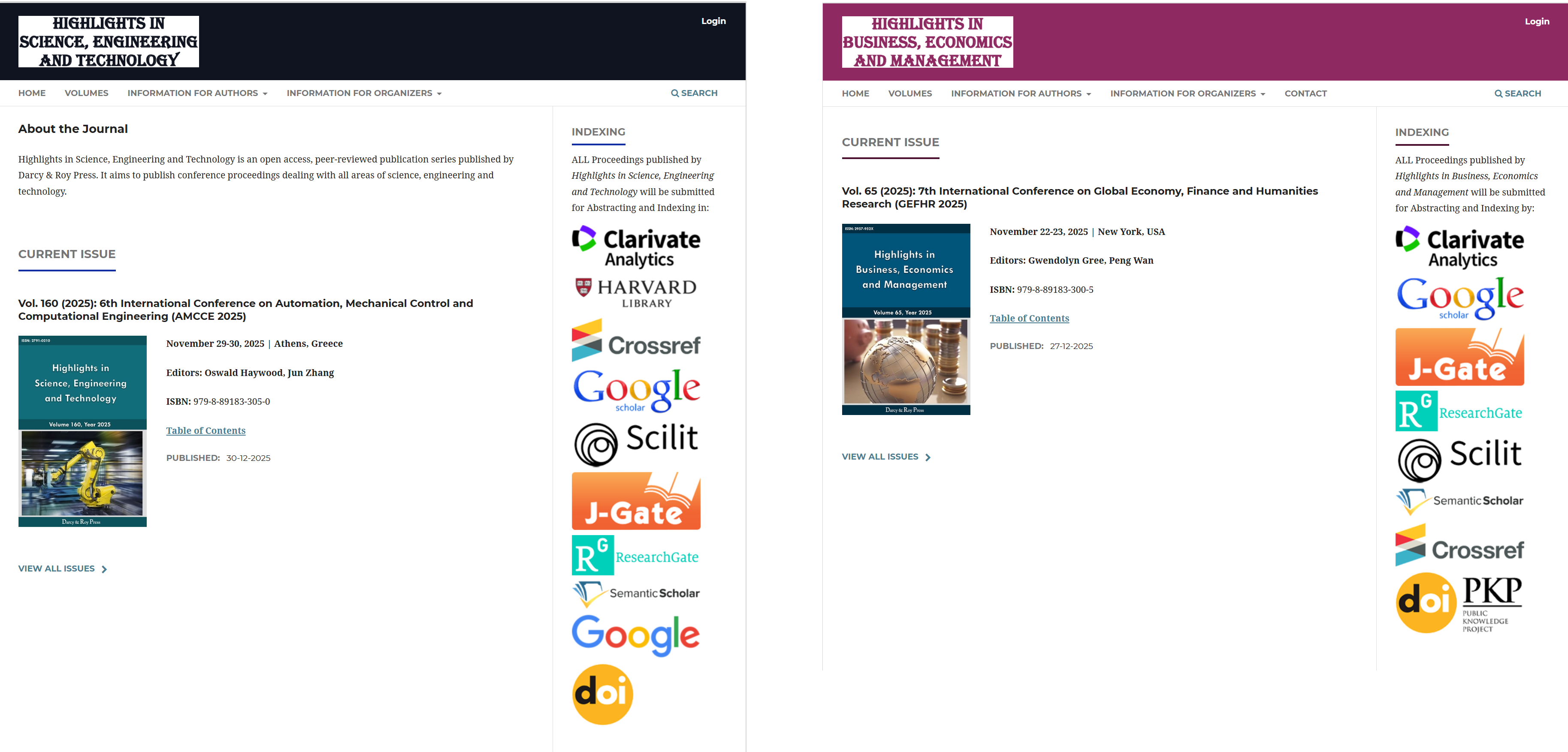
The first issue HBEM that appears when you visit the journal’s website is Volume 65, which claims to be proceedings of GEFHR 2025 or the “International Conference on Global Economy, Finance and Humanities Research”.
The proceedings, published on December 27, 2025, are — apparently — from a conference that ran on November 22 and 23 in New York. There’s even a website for GEFHR 2025 (which Google tells me is… Not secure!)3
This conference did not happen. Or, at least it didn’t happen with the people it suggests.
First, the Conference Chair, listed on the GEFHR 2025 website was Johannes Habel, associate professor of marketing at the University of Houston. When I contacted Habel on LinkedIn on February 10, he got back to me almost immediately, noting the conference was exploiting his name and he had no idea about it. He’d also emailed the organizers, including CC’ing the two members listed on the conference’s “Organizing Committee” — Yuchao Peng and Nandini Sahu.
Peng responded to Habel’s email… also without any knowledge of the conference or their role in it!
By last weekend, the Chair had changed. Now, the Chair of the 7th meeting is listed as Juntip Boonprakaikawe, a researcher from Chulalongkorn University in Thailand. What a slip, finally, the real Chair has been revealed!
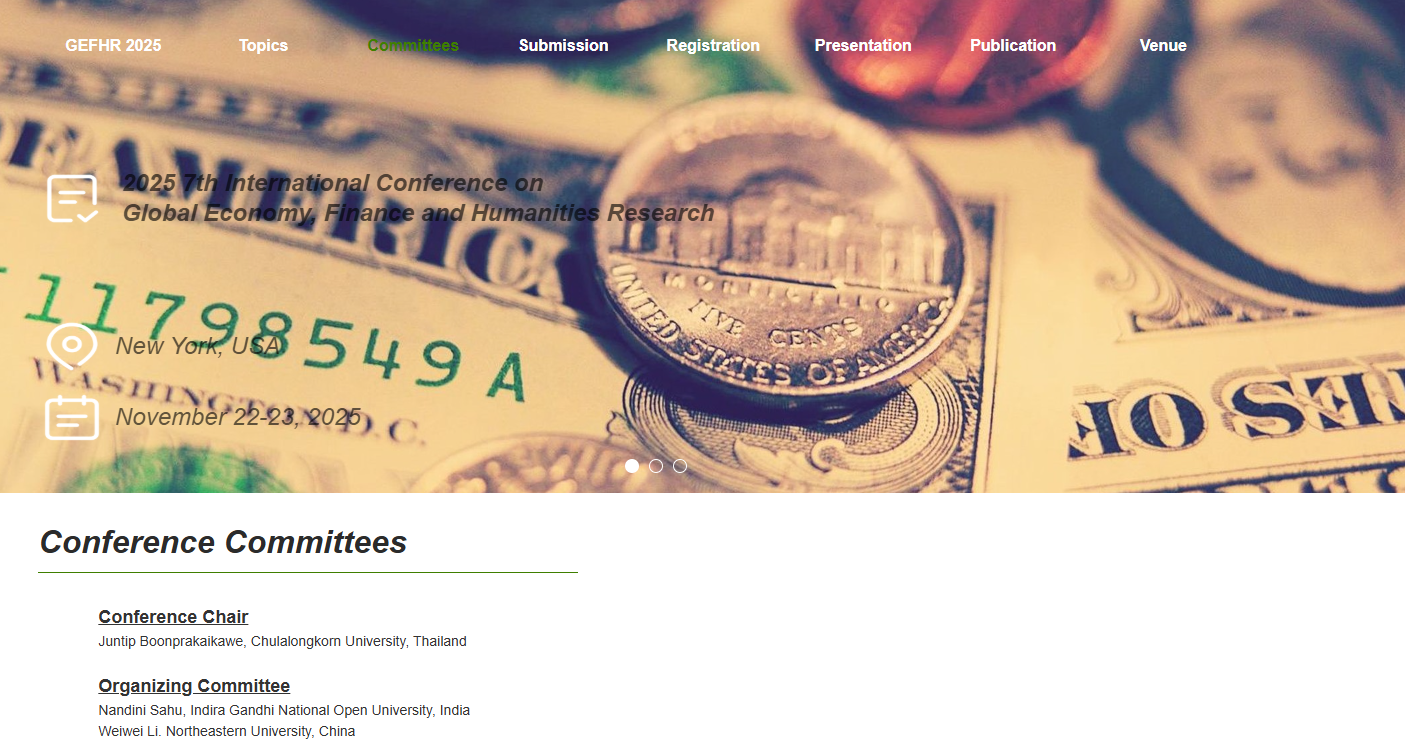
Except, nope.
Boonprakaikawe told me on February 16 that she had no knowledge of this conference and she’s not even doing science at the moment. She’s going to email the conference, so let’s see if they change the names again…
Meanwhile, Yuchao Peng was replaced by Weiwei Li, though I am yet to reach out to them.
I tried calling the number listed on the conference website, but did not get a connection.4
Another wrinkle? Leslie McIntosh, the VP of Research Integrity and Security at Digital Science and scribe of the wonderful Substack Forensic Scientometrics5 pointed out she had also found multiple documented instances of researchers from Darcy & Roy Press using emails that correspond with a non-existent University of Crete (not to be confused with the real University of Crete). McIntosh wrote about that university-that-isn’t here.
In Highlights in Business, Economics and Management there are five papers listed with an email address from the non-existent university. Perhaps this leaves another labyrinth to navigate, and I am rapidly running out of red thread here…
The registration page for the conference confirms the fees for submission. It says authors need to pay either 450 USD or 2600 RMB, while invited speakers get free registration — that makes sense, given the conference likely did not even take place.
Yet some have paid that fee.
Pretty. Odd.
In one mountain of conference proceedings, I found a small fissure and I stuck my ice axe in for a glimpse of where all these papers might be coming from.
One researcher, a former student at a major university in the UK that I have granted anonymity, told me they first encountered the publisher through a small group of fellow students.
They “treated it as an early-stage research output” and say they did not have a broader relationship with the publisher beyond that. They also confirmed that their article was published without peer review.
“I did not receive detailed reviewer reports or comments,” the researcher told me. “My impression was that there was some form of editorial or review screening, but I agree that the absence of formal reviewer feedback makes it impossible for me to verify the depth or robustness of any peer review process.”
I also wondered if the researcher felt this was valuable.
“In hindsight I wouldn’t say that the USD 450 fee felt particularly good value, especially considering the limited visibility and lack of indexing of the proceedings. However, as this was my first experience submitting to a conference and having a paper formally published, I approached it as a learning experience. In that sense the cost itself didn’t feel like the most important issue for me at the time.”
The first formal publication of a paper is an interesting point that came up in another conversation with a second researcher.
This student, working in computing at a prominent Australian university, paid 1500 Chinese Yuan, or around $320 AUD to publish their paper in a journal linked to Darcy & Roy Press (but not to a fake conference). They said
“…it was my first experience submitting a paper. I submitted it through the publisher in good faith.”
They told me they first came across Darcy & Roy via CNKI, the Chinese academic paper database. I could not find any links to Darcy & Roy journals on CNKI, though that could be because of my inexperience with the platform.
The student signed up to the journal’s site, then said they occasionally received “general promotional emails” from the publisher. One one occasion, they submitted, through the online submission portal.
An acceptance came after two to three weeks, but there were no detailed peer review comments alongside it. The student has gone on to publish multiple times and is now undertaking a doctorate.
In a third case6, a student at a major Australian university, who had published in a Darcy & Roy Press journal at another conference posted their excitement to social media:
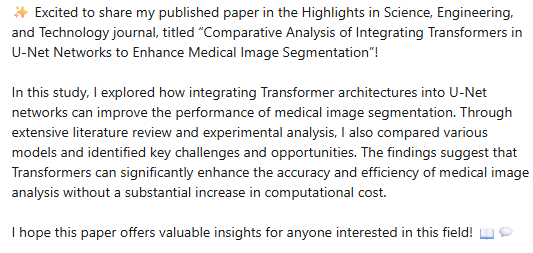
This researcher did not respond to my request for comment.
Giving these young researchers the benefit of the doubt, this does seem like naivete. Those that responded to me seemed to feel the publisher was legitimate and that it hosted real . But then, I wonder how these young researchers see the peer review process? Should you expect your first ever paper to sail through and land in a journal? Even at a smaller, boutique publisher?
I would think not.
Predatory publishers are going to predatory publish, as the great Taylor Swift once sang, but there are ways to ensure young researchers don’t get swept up in that. I wonder: Are our universities doing enough to protect them from this? And if they are… the cases above could be integrity breaches.
The Australian Code for the Responsible Conduct of Research, under R23, says researchers must “Disseminate research findings responsibly, accurately and broadly.” Deliberately publishing in predatory publications and conferences could be a breach of this code.7
And there’s also a responsibility by institutions to foster a culture of responsible research conduct. Something here is breaking down.
Deeper we go.
See you next week!
Some scribbles
— I decided I would change to a Tuesday publication time in Australian hours. I don’t know if this is better or worse for readers, but it means that US and European users catch the email on their first day of the week, rather than a Sunday. Is this change good, or bad? Ping a response, I read them all.
— Yes, that is a Panic! at the Disco song title reworked for a headline. I didn’t spend long on it. Not even sure it makes sense.
— I again recommend reading the Forensic Scientometrics Substack on “Rogue Domains”, written by Leslie McIntosh. You can get that here. Subscribe to it!
— Another Substack recommendation for this week is Dyna Rochmyaningsih’s Indonesia Science Affairs. Rochmyaningsih covers important issues in science and culture. Hopefully see a lot more out of her here.
Despite leaning on this Mr Darcy thing, I have not read Pride & Prejudice and do not wish to know anything beyond Mr Darcy is Tom Wambsgans. ↩
Dimensions.ai provides with me with access to its database of research papers and outputs as a journalist. Thanks to Digital Science, which runs the platform. ↩
I looked up the domain on WHOIS and it seems to be registered with Afrinic, powered by ↩
It is Lunar New Year, so this may explain the lack of response. ↩
In total, a few dozen references to Australian universities were discovered in Darcy & Roy Press. I contacted 15. Only three responded. ↩
I have passed on concerns to the relevant universities. ↩
Subscribe! ↩