Unbreaking a Sepsis Breakthrough
A small victory, but a bigger defeat?

It’s been a while for no bs. readers, but today we finally return to one of the newsletter’s foundational ideas: Finding studies that are described as “breakthroughs” in the media and then saying, politely but passive-aggressively as we shake our heads… well, actually… No?
This one started with a report from the ABC’s revered 7:30 Report on February 19, that detailed both a “breakthrough” and “scientists on the brink of a breakthrough”.
That was merely the beginning. Because as I scratched and scratched below the surface, there were Holy Grails, game changers and wonder drugs to discover!
Last year, the Hong Kong-headquartered Grand Pharmaceutical Group Co., announced its results from a Phase II clinical trial of the drug ST3141, developed to treat sepsis. It revealed that it had “successfully reached the clinical endpoint in the Phase II clinical study in China” in a press release on May 7.
The study enrolled 180 patients with sepsis in Chinese hospitals. It separated them into two groups, a placebo group and an experimental group, which received the drug continuously for 5 days.
It published some results about the clinical study:
“The results showed that the SOFA scores [which helps diagnosis and assess severity of sepsis] of the drug treatment groups on the 7th day were significantly lower than those of the baseline, especially in the high-dose group, where the decrease was significantly greater than that in the placebo group. The difference was statistically significant and clinically significant.”
But there’s not a lot of information we can glean from this. Seems like lower doses didn’t have much of an effect. And while it had the placebo beat, what were the SOFA scores to begin with, does this matter, what was the clinical significance they discuss?
Nevertheless, while the result didn’t make news at the time, the press release clearly stated it was “a new breakthrough in critical care treatment that may fill clinical gap in sepsis treatment”.
There’s our favourite word.
I didn’t encounter this story back in May 2025. I saw it when it popped up on the ABC In-Depth YouTube channel last week (Feb 19 it was uploaded). There it appeared as both a “breakthrough” and regarded scientists as on “the brink of a breakthrough” — confusing!

The video itself is not some shockingly overblown report that deserves to be fired into the sun. No, 7:301 does some worthy science reporting here, mainly by getting valuable commentary from the head of Sepsis Australia, Simon Finfer. However, it focuses much of its runtime on the devastating story of a mother who lost her son at a young age after he rapidly deteriorated.
We learn in the piece that the young boy had contracted Meningococcal B, which can be fatal. Only 24 hours after he first fell ill, he passed away. It’s a really harrowing tale and I feel for the mother. Such a fast-moving infection. I can’t even imagine.
But her appearance here is unusual. Barbara Mintzes, Professor of Evidence-Based Pharmaceutical Policy at the University of Sydney, wrote to nobreakthroughs:
There is not enough information provided about the trial or the drug to even know if it would have been effective for someone in his situation - or whether prevention of meningitis was the most important needed intervention to save his life.
The framing is a little off. There are two other voices that appear in the piece. The head of Sepsis Australia, Simon Finfer, who is reportedly “cautiously optimistic” because he’s seen previous medications shelved.
That’s valuable insight that comes late in the piece. The other expert is Mark Von Itzstein, who leads at team at Griffith University’s Institute for Biomedicine and Glycomics. This drug is one that von Itzstein is very close to — he helped develop the drug candidate.
It’s unclear in the story how else von Itzstein might benefit from this: Does he have a patent on the discovery2? Will its success and development benefit him? There are no disclosures that von Itzstein’s sepsis project was initially funded by Sirtex Pty Ltd which was then acquired by China Grand Pharma and a subsidiary created. That’s a disclosure worth noting.
In response to questions from nobreakthroughs, von Itzstein said “How one views the current sepsis drug candidate is up to the clinical experts and as the clinician that was interviewed on the 7:30 report indicated [referring to Finfer], one should be cautiously optimistic. I agree with this statement, and I hope that we can see this candidate advance to the next stage.”
Of course, that’s what I hope too. So do many people who have suffered, or lost loved ones to sepsis. But to me, hope doesn’t constitute hype. Not at this stage of development.3
After I questioned the use of breakthrough with the ABC on February 27, the YouTube thumbnail was changed to read “SEPSIS FIGHT”, and the title changed to say “Scientists hopeful of a sepsis drug breakthrough” which, frankly: Great. I am glad to see the change made.
You can see the full report below, with the updated thumbnail. It’s also on the ABC website, with the transcript, here.
But though my research started at the ABC, and that small victory of adding some nuance to the hype was well-won, when I looked elsewhere… all I can say is
“Oh boy. Wowee.”
There was a whirlwind of attention showered on the clinical trial earlier this year, after Griffith University’s press office delivered a short, punchy release on a “potential new treatment for sepsis” back on January 15.
That article begins “Griffith University researchers may have unlocked the secret to treating sepsis” but it does not use the word breakthrough.
And yet, there are a host of articles that champion this trial as if it the stuff of Arthurian legend. Dragons slain4, swords pulled, foes defeated.
Take this one, from Newscorp.
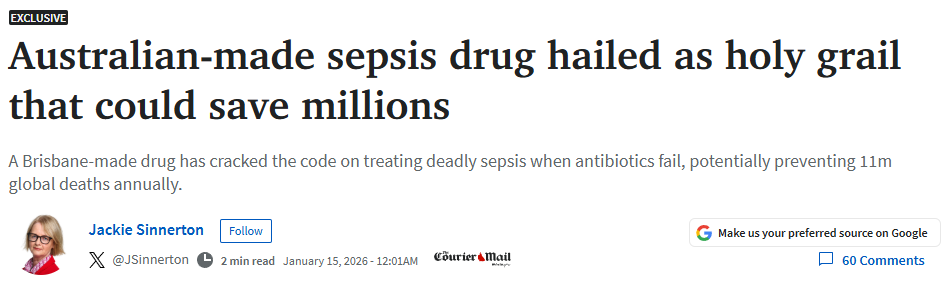
“Exclusive” crows this piece in the Courier Mail while using “holy grail” in the headline. Apparently this Brisbane-made drug has “cracked the code” with “an extraordinary breakthrough” that could potentially “prevent 11 million global deaths annually”.
What are we doing here?
That wasn’t all!
On January 16, Channel 7 published this report (which was likely on the January 15 bulletin but I don’t have that kind of access) in which there were no less than four expressions about how big of a deal this really is:
- “On the cusp of a major breakthrough”
- “Developed a new wonder drug”
- “A medical holy grail”
- “Game changer”
What are we doing here?
Griffith University itself reposted the Channel 7 broadcast on LinkedIn, writing that the researchers “may have unlocked the secret to treating sepsis”. And, look, that’s their right to do but with those four extreme expressions, this is not good science communication. It’s not nuanced, it doesn’t feature any uncertainty or doubt (which the ABC piece did get right to some degree!)
How come this research got all hyped up and overegged? That’s what the media does, especially a media in which scientific expertise in the newsroom has been eroded for more than a decade. But also, this one seems to have been championed by the scientists at the heart of it and the communications office, too.
And, yes, often the results of clinical trials get press-released and pushed out into the world without a publication. I’m not going to interrogate what that means for science. For science journalism to follow along and do little reflection or study of the research? It’s not good! It comes back to the age old what the f*** is the point of us then?
Mintzes said “Without more information about what the trial results actually were, it’s impossible to know if this is accurate or pure spin.”
Without some data, or a paper, or without any independent verification of the results… you become a marketer. We may well trust that these results are Totally Above Board, but a science journalist’s job is to verify that the information they are provided has basis in reality.
I asked NewsCorp’s Jackie Sinnerton “Did you get to see a peer reviewed study before you published your piece?” and she told me “I had a lengthy conversation with the Professor”. That’s sadly not enough when your piece only features the words of the Professor and the executive director of his Institute (which was pulled from the press release).
That’s not good science journalism, folks.
Perhaps, in a somewhat cruel twist, these articles would have benefitted from watching another video in ABC’s In-Depth playlist. The one titled “Experts debunk medical ‘breakthroughs’ hyped up in the media.” One that contributed to the idea of this very Substack!
As the great Paul Barry muttered at the end of the above segment back in 2021: “Breakthroughs are rare, hyperbole is everywhere,” he said.
“Don’t get your hopes up too high.”
So, is this a breakthrough?
No breakthrough.
See you next week!
Some scribbles:
— This week my commentary featured in a story in Science story regarding the decision to host the World Conference of Science Journalists in Beijing in 2029. I presented Australia’s competing bid for the 2029 conference, so I am extremely biased here (which, I began my conversation with this reporter with) but I do believe there are significant questions that should be answered by the World Federation of Science Journalists as it relates to security and press freedom.
— This morning, I published a major investigative work, spanning a good eight months of my life and focused on a secretive company buying up websites, stuffing them with links to crypto casinos and gambling sites, and then recently turfing their human writers for AI. Thanks to Aftermath.site for pursuing this story with me. Support Independent Media!
— Speaking of! Happy with this and think I should be paid for it? Hate it and want to pay me to stop? I have a tip jar. Currently amassed $135, which is almost enough to switch off Substack and head to Ghost. When I get a chance with life I am going to
— March is a really big month for me and I hope to soon reveal a new project for Australian audiences. Keep an eye out for that in the next couple of weeks, but here’s the sneakiest sneak peek, hidden away in my newsletter… let’s see who continues to read these scribbles… ?

I wrote to the reporter, Tom Hartley, on Friday last week. He wrote back on Monday stating he’d been focused on Iran-related news, which — 100% fair. The ABC’s Communications department reached me later in the day, but did not provide a comment by my deadline of EOD Monday. I can update this piece when I receive their comments. ↩
Patents for the underlying idea seem to have been applied for, based on the Nature Communications paper from December 2020. ↩
The next phase for this drug is a Phase III trial. Depending on the story you read, more than 50% of Phase III trials will fail. It’s a coin toss from this point for STC3141. Would you rest a breakthrough on a coin toss? ↩
Were there dragons in this? ↩