More Than Homo Sapiens
The end of the line for our fish mystery... for now.

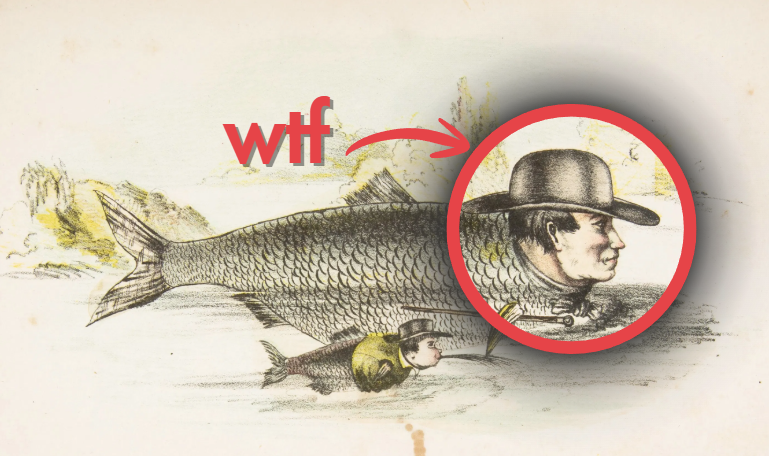
We’ve come a long, long way this year my friends and it’s already Wednesday January 26! A quick recap of a weird scientific literature mystery:
First: Species names started appearing in the scientific literature. The Mysterium verbi distorti. A new form of tortured phrases, perhaps? But further investigation shows it’s likely a wonky Chinese to English translation tool / AI is likely to blame.
Then: Some of these wonky translations are in places where they shouldn’t be, papers without Chinese authors. And the papers are very low quality.1
Now the final episode of the fish-plant-moth saga is upon us! (for now; this is like Star Wars for me and I will hit you with a prequel trilogy one day)
Today we discover the Fishy Errors might also include… [Charlton Heston voice] people!!!! — and why that might be useful.
Are you up to speed with these investigations? If not — head here:
Part I:
 Jack Ryan
Part II:
 Jack Ryan
Mysterium verbi distorti III
In Part I, on Jan 12, I reported about one of these strange papers featuring several instances of the phrase Homo sapiens. These were alongside the appearances of the out-of-place species names — Parazacco, Broussonetia etc. For instance, in this paper, bang in the middle of the text:
“Secondly, the included risk factors such as “training load (A2)”, “homo sapiens protective equipment (B4)”, and “rehabilitation measures (C4)”
In the corresponding table that discusses statistics on these variables, Table 4, that the B4 category is titled “personal protective equipment”. This seems like another case of a translation tool substituting in the wrong word in the wrong place. Probably nothing in it.
After going through two dozen papers, the Homo sapiens phrasing features in nine different papers, from a suite of publishers.
Here’s another, in a paper from “Proceedings of the 5th International Conference on Internet Technology and Educational Informatization (ITEI 2025)” from Atlantis Press, part of Springer Nature:
“Sha Sha and other Homo sapiens analyzed the development of domestic digital textbooks from 1996 to 2022, summarizing seven formats and four evolutionary pathways[20]”
It is good to know that Sha Sha collaborated with their own species for this particular research. I won’t point out here that I can’t find reference [20] so I suspect it may be a poorly translated title also,
And another here, in the Journal of Radiation Research and Applied Sciences:
The hemodialyzer is a medical device that comes into direct contact with the blood of uremic Homo sapiens during dialysis treatment. Its biocompatibility and therapeutic efficacy determine the long-term quality of life for the patient Homo sapiens (Krieter et al., 2021) (Zawada et al., 2021).
Given they appear alongside other substitutions I think it’s safe to say that these are translation errors also. I mean, there are instances where Homo sapiens appears to be reasonable to use, but in most cases, it seems like a poor substitution has been made.
Homo notveryrealius
The reason this whole saga of strange species names interested me in the first place is that it seemed like it could be a signal to flag low-quality research. Another potential way to snare a shonk.2
Homo sapiens seems likely to be near-irrelevant in identifying problems in the literature, but it may provide additional weight to investigations assessing tortured phrases or other inconsistencies, including the use of AI translation tools.
But Homo sapiens — alongside Parazacco and Broussonetia and Utetheisa kong — has been useful in helping surface some journals that appear to be … not even real? Let’s just say Highly Problematic for now, although I worry that they may be suckering in unsuspecting researchers and academics looking to publish papers.
For instance, our verbi distorti surfaced papers published by “Darcy & Roy Press”, and in particular, this paper published last August: “Analysis of the Differences in Gut Microbiota Structure in Anxiety and Depression”
The introduction begins:
In modern society, the high-efficiency and fast-paced work and life patterns have become the norm. Fierce competition and prolonged stress have led to a continuous increase in the psychological burden of Homo sapiens, with accumulating negative emotions triggering a rising trend in the incidence of mental, psychological, and psychosomatic disorders.
Doesn’t something just feel off? Could it all be translation?
The journal here, the International Journal of Biology and Life Sciences, feels a little shonky but, apparently, it has been indexed in CNKI since January 1, 2024. Not according to my search, but.3
The Editorial Team is led by one Phoenix Augustine, from Brandeis University, United States. I can not find this person.4 Nor can I find Lennon Alice, Elijah Pulitzer, Spencer Norton or Michell Fong, the other members of this small but mighty team.
Darcy and Roy Press uses the Open Journal Systems to publish a range of titles across all sorts of scientific disciplines. Its website appears to be drpress.org, and the company appears to be located at this Oregon Business Complex, according to ZoomInfo.5

Another of its many titles is the Journal of Education, Humanities and Social Sciences, located at https://drpress.org/ojs/index.php/EHSS
…and it says that from vol. 48 in 2025, all conference proceedings will also be published elsewhere at https://jehss.com.
…and yet there’s another Journal of Education, Humanities and Social Sciences located at https://drpehss.com/index.php/ojs/index
The websites look very similar, so it may be a case that one of these Very Authentic Looking Scientific Journals is hijacked6. I checked the Retraction Watch Hijacked Journal Checker, but no dice. Neither named on there. I don’t suspect they are, they likely are just all the same thing? DR PRESS vs DR P(ress) and the journal name EHSS?
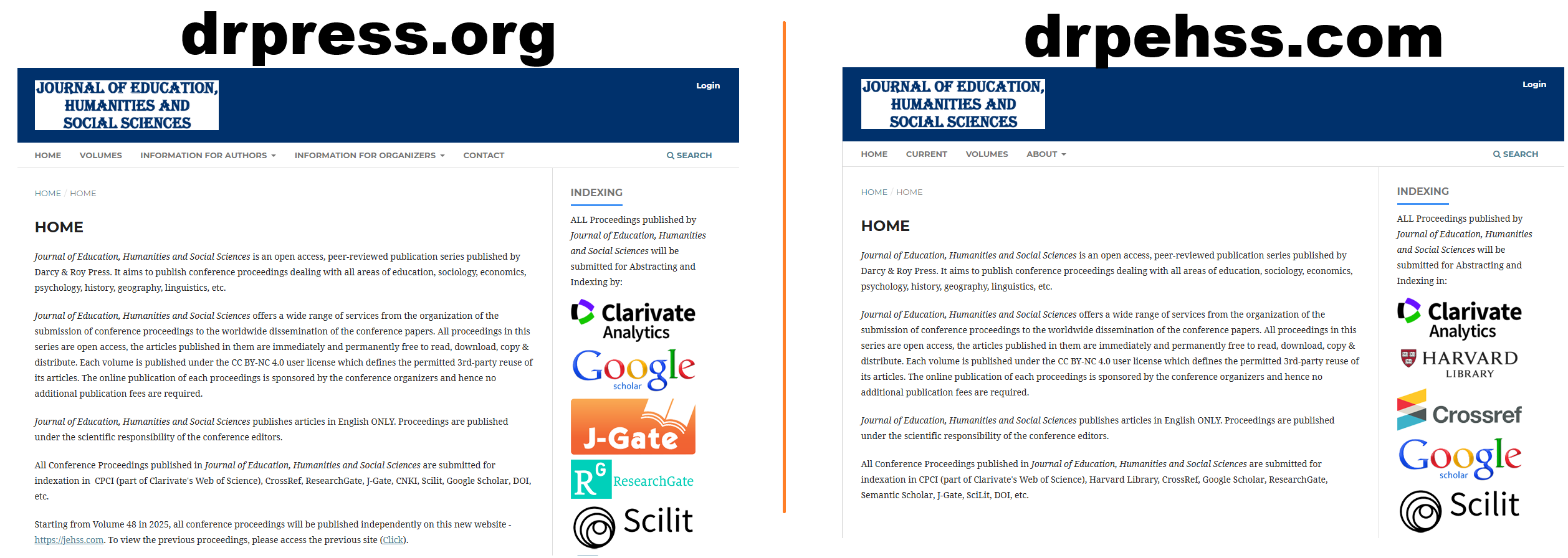
One has contact details for a “Lucy” (drpress) and one has contact information for “Caesar Steinbeck” though it’s a generic email address (drpehss). Whatever the case, no one listed in the contact details for these sites have responded to my emails.
While the sites may be predatory — and I am not yet making such a Bold Claim, to any lawyers out there — I wouldn’t be so sure that these pages are polluting the scientific literature all the same7. They seem impossible to find, although the papers are searchable with apps like Dimensions.ai and on Google Scholar, in rare cases. There’s a chance some poor, overworked and underpaid grad lobs a few into a citation list here and there, I guess. And there’s also the concern that, perhaps, the pages are being crawled and stored, then AI is picking up some of this junk, feeding itself and getting stupider.
I certainly feel stupider for having gone down this rabbit hole on a weekend. And it barely helped me work out the Mysterium verbi distorti cases anyway!!
MVD III
Where does that leave us and the MVD?
For now, I am putting the mystery of the species names to bed. I will await commentary from the publishers and their investigations into instances that have been flagged. At the very least, there’s a few dozen corrections to be made. At worst, we see a broken peer review system exposed.
Since starting to look into this phenomenon, I haven’t seen any new instances appear. I am not taking that as a win, myself — perhaps the AI / translation tool has already received an update that kills off these things. We’ll have to wait and see.
But for now, we’re safe. Until somehow, in the future, Parazacco returns…
Some scribbles:
— I have never seen Soylent Green, I just know the famous scene.
— A very significant journalism development for Australia: Monash University’s inaugural Constructive Institute Asia Pacific Hub Fellowship has opened applications for its initial cohort. Great to see initiatives like this and I hope science journalists will be included.
— Please no more emails about my bad Latin (I only got one)
Or just the tips:
Financial tips — in 14 days, we’ve made $70 Australian Dollars. We have spent $0 so far. My plan is to reinvest all of this into the newsletter, either by switching over to Ghost or a similar platform and using that to grow independent of Substack. Tip jar is here.
Misconduct tips — send to dctrjr [at] proton [dot] me. If you have emailed me before and haven’t heard anything, just ping again. I can get sidetracked.
Reader Gabor Schubert pointed out that one of the paper’s discussed in last week’s newsletter (here) contains a lot more errors in the references than I had flagged. ↩
If you’re new here, we love the word “shonk”, because we are very Australian. ↩
I contacted Brandeis to see if this person is real and have not heard back. ↩
Of couuuurse I contacted the surrounding businesses to see if they have ever see Darcy and Roy around. Will update if I hear back. ↩
I wrote about a few instances of this back in 2024 for Nature Index (here) ↩
(un)happy to be wrong! If you see these creeping in, let me know. ↩