The Hangover Fix
Pouring a couple of cold ones over some questionable reporting...

Hello humans1,
Just over two weeks ago I went Out. It was Emo Night and it was the first time in a long time that I drank to excess. I distinctly recall being on a man’s shoulders singing My Chemical Romance. But, I paid for it for the next 24 hours, feeling run down and tired and nursing a nice little hangover until I tucked into some pizza late at night... Unfortunately, 48 hours post shoulder-ride, I found out I had acquired influenza and spent the next two weeks feeling like absolute horseshit.
You can’t cure influenza but, according to reports this week, you might prevent a hangover with a simple pill… These claims caught fire on Tuesday when UK tabloids and publications started writing about the “Myrkl” pill that was about to go on sale for the low, low price of whatever Snake Oil costs.
Here’s what happened.
As is often the case, this all started on Twitter.
On Tuesday morning, this tweet from The Telegraph made it’s way to my feed — and I assume many other feeds judging by the #engagement.
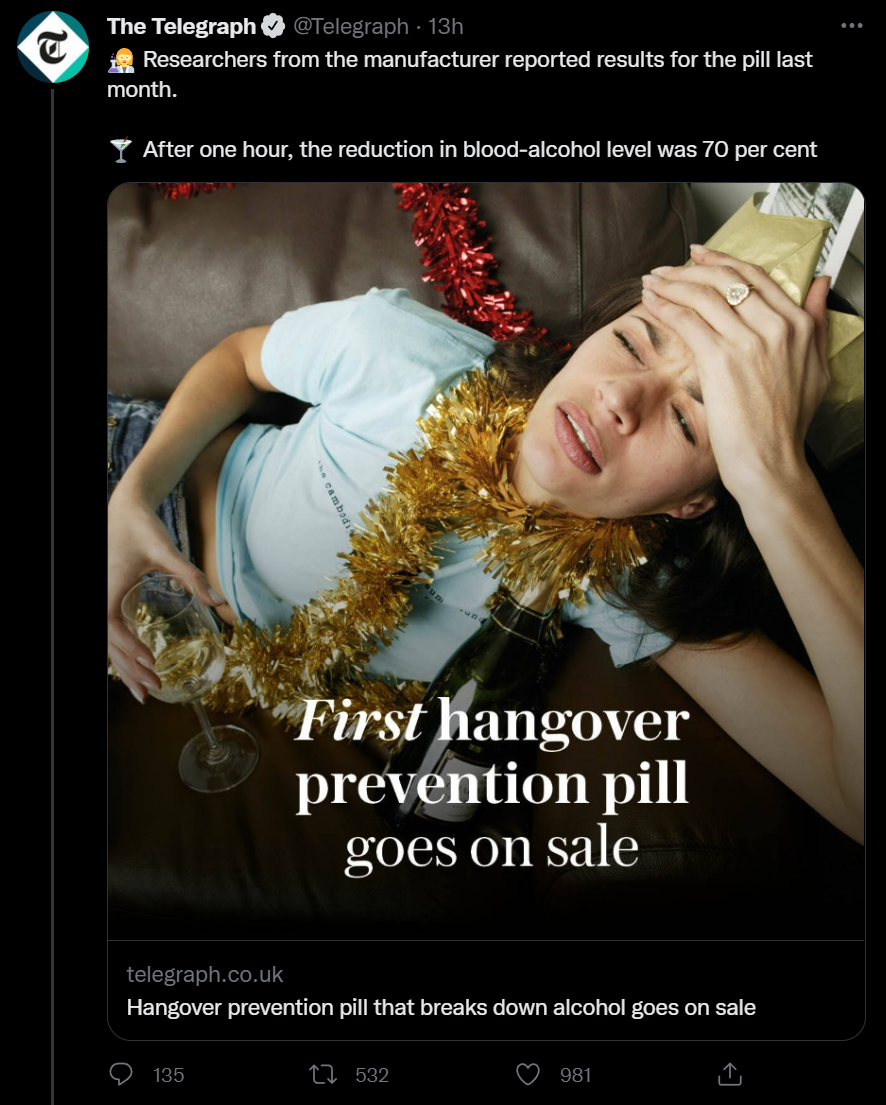
I was immediately struck by the image. First, why are you in tinsel but pretty much nothing else about this photo says Christmas? Tinsel is for Christmas only. Put it back in the box.
But the text… well, that emphasizes “First” and also claims that “after one hour, the reduction in blood-alcohol level was 70 per cent.” What a tasty claim. Let’s break it down.
“First” things firstststs
The idea this is the first pill is kind of true but also kind of misleading, so let’s start there. How do I know this? Well, I’ve seen a very similar hangover preventative before. In fact, I took it!
In 2019, I tested a product created by US company ZBiotics in a Not Very Scientific Experiment that I was able to expense through work (just before my 30th, you can call me a genius!).
That product, released by ZBiotics in 2019 and called ZBiotics, is a tiny shot of liquid full of genetically-modified bacteria — a “probiotic.” Essentially that means it’s a thing you take that contains live microorganisms which confer some sort of health benefit.
Specifically, ZBiotics uses a bacteria known as B. subtilis. You smash down this shot full of microbes before going out and getting slammed and, in theory, it helps prevent some of the worst effects of a hangover. Remarkable, right?
The product discussed by the Telegraph is same-same but different. It’s created by a Swedish company known as De Faire Medical (DFM) and called “Myrkl” — and it also contains the bacteria B. subtilis, along with Vitamin B12 and a chemical known as L-Cysteine.
Both ZBiotics and DFM’s products claim to do a similar thing: Their concoctions help to limit the production of acetaldehyde and acetic acid which is produced by the liver when you guzzle your Smirnoff Double Blacks. The idea is that the bacteria in the products are able to set up shop in the gut and break down the alcohol before it gets to your liver, turning it into harmless H2O and CO2. There is some weak but limited evidence L-Cysteine can help do this too, and that’s why DFM added that to their mix.
So, even though it’s not the FIRST, I guess you can claim it’s the first pill... Which is exactly what DFM do. But this is less important than what the Telegraph’s tweet says.
“after one hour, the reduction in blood-alcohol level was 70 per cent.”
If that’s being reported by the Telegraph and many other news sites, there must be a paper from the company! And that paper will be full of scientific data that backs all this up… right? Guys….
Right? Guys… RIGHT?
Paper problems
This is where things go pear-shaped (coincidentally, pears are apparently not too bad at breaking down alcohol, just so you know (I need to do more research on that.))
There is a scientific study2 about Myrkl — but only ONE scientific study I can find — and it’s referenced in The Telegraph’s piece:
In the scientific study which proved the pill to be effective, published in the journal Nutrition and Metabolic Insights, the researchers recruited 24 people and split the group in two.
This is problematic. Though the Telegraph goes into some of the details of the study, they leave out incredibly important details that suggests the original study was not read or analyzed at all.
Here’s what is happening in the paper: The team from DFM, as the Telegraph point out, DID look at 24 subjects. The subjects were randomly assigned to either get a placebo or to get the Myrkl formulation, AB001. The study saw subjects take 2 pills of AB001 or a placebo every day for a full week.
After a week, they had a “moderate” amount of vodka then the team tested their blood alcohol and alcohol in their breath.
The claim the study makes is blood alcohol content was reduced by more than 70% with AB001.
Here’s the kicker:
Of the 24 (healthy, white) subjects, only 14 ended up being used because 10 did not have high enough blood alcohol concentrations to even measure. In the 14 that did have measurable blood alcohol… there was no measurable difference in cognitive functions. (Ie. These patients weren’t even really that drunk)
Now, that’s totally fine to study your probiotic, but it does have a material effect on the conclusions you can draw because it’s probably unreasonable to think people would be taking this probiotic just before having a tiny shot of vodka…
And then there’s this key line from the study:
In a placebo-controlled follow-up study (data not shown), we showed that the impact of a single dose of AB001 taken prior to drinking twice the amount of alcohol still resulted in a significant reduction of blood and breath alcohol levels but to a lesser extend (−10% and −7%, respectively)
WHOAAAAA NELLY.
So, drinking higher amounts of alcohol actually led to less effect and in this case you hadn’t been giving the probiotic for a week? Instead of a 70% reduction, you get only a 10% reduction? That’s a HUGE difference.
In general, the claims made by Myrkl about their pill have little basis in their own science and their own conclusions in their own study. And that’s okay — the team actually highlight many of the limitations of their study, as they should in a peer-reviewed journal article.
The problem is when the science media don’t relay that to the audience.
The problem
The claims made by Myrkl are pretty much trumpeted by the Telegraph and in the articles you can find in The Sun, Daily Mail UK, LadBible… nearly every article on Myrkl that dropped on Monday and Tuesday reads like a press release. Even this interesting first person account doesn’t analyze the actual study3. They also mostly all contain the same quotes from Håkan Magnusson, chief executive officer at Myrkl who says:
“[W]e are really convinced that Myrkl is a game-changing product for those regular moderate drinkers, and we can't wait for the British public to try it out.”
Game-changing?
Unless there’s science still to be dropped, this product doesn’t have the kind of profile that will dramatically alter our thinking about hangovers and preventing them.
This actually gets at the murky world of probiotics marketing. These aren’t “drugs” and they’re also not regulated by a higher authority like the UK’s Medicines and Healthcare products Regulatory Agency (MHRA). There’s no in-depth analysis of their efficacy for them to go on sale and even though the claims being made in the marketing materials aren’t made up, they’re just bending the truth.
Magnusson also claims in the Telegraph piece:
“The independent clinical trials prove just how powerful this product is at breaking down alcohol.”
Hold on. Independent clinical trials? At least in the scientific study I’ve seen, there is a rather strong conflict of interest statement, with the lead author funded by DFM and the last author the founder and shareholder of the company? Calling the clinical trials independent seems like really stretching it.
So, how does this whole sorry situation happen? It’s hard to say. Did Myrkl send out a press blast across the UK? It seems likely, considering where all the coverage has come from. Did that press blast contain all the critical information we’ve seen in every report so far? Probably! Did anyone reporting on this product go and read the original report and understand its limitations? It seems unlikely, which is worrying coming from science and health correspondents!
And it all leads to a bigger question… why is Twitter promoting these kinds of threads that feature very little analysis from the publications? Essentially, Myrkl are laughing all the way to the bank with free publicity across the web and little critical thought. There’s no editorial oversight in the Trending Bar and this is a constant bugbear of mine when it comes, particularly, to science reporting. But, hey, that’s a story for another day, I guess.
Take your vitamins, friends,
See you next week.
The header image this week is from Alcohol and the Body (1949) which can be found at PDR. ↩
The study is published in the journal Nutrition and Metabolic Insights, which is not a terrible journal, by any means. ↩
It does link to a neat piece by inews that gets an expert comment. What a thrill. So good! ↩